


The census conducted in Greece in 1928 counted 72,791 Jews, 1.2% of the country's population. The vast majority of the Jewish community (over 98%) resided in cities. The largest Jewish community in Greece was in Salonika (Thessaloniki), where 55,250 Jews lived in 1928. Only 1,578 Jews lived in Athens, the capital of Greece, in that year. It is therefore no wonder that the Holocaust of Greek Jewry is linked in Jewish memory to the tragedy of the Jews in Salonika, one of the oldest Jewish communities in Europe, where Jews are believed to have resided as early as 200 B.C.E.
The war reached Greece about a year after it began in Europe. On June 10, 1940, Italy under Mussolini contracted an alliance with Hitler, and the Italian army attacked Greece on October 28, 1940. Mussolini demanded that Greece open its borders to the passage of the Italian army, and when Greece refused, the Italians attacked the Greek army along the border with Albania. The Greeks repelled the Italian invasion and pushed the Italians back into central Albania. On April 6, 1941, the Germans invaded Greece through Bulgaria and Yugoslavia. The British army failed to prevent the German conquest of Greece and the Isle of Crete.
Greece was divided into three occupation zones: German, Italian, and Bulgarian. The Germans kept a strip in eastern Thrace, central and eastern Macedonia, and the Isle of Crete under their rule, the latter because of its strategic importance for control of the Eastern Basin of the Mediterranean Sea. Salonika, where most of the Jews in Greece resided, was therefore under German rule. The Italians received central Greece, including Athens, the capital, the Peloponnese, and additional territory on the west coast of Greece. The Bulgarians received western Thrace and eastern Macedonia. Greece officially kept its independence, and a government of collaborators was established in it.
The figures given at the Wannsee Conference in 1942 referred to Greek Jewry as a single mass of 75,000 Jews. However, the fate of the Jews in Greece, 90% of whom perished in the Holocaust, differed from one occupied area to another. In the first stage of the Final Solution, the plan was implemented for the Jews in the German-occupied zone (where most of the Greek Jews lived) and the Jews in the Bulgarian-occupied zone. In the second stage, after Italy surrendered to the Allies and the Germans took over northern and central Italy in 1943, the extermination policy was also applied to Jews in the Italian-occupied areas, but the plan's implementation was postponed and delayed until the spring and summer of 1944.
In February 1941, before the German invasion of Greece, the Sonderkommando Rosenberg unit was set up in Germany, headed by von Ingram. The unit had over 80 members, divided into two groups. One was sent to Athens and the other to Salonika. On November 15, 1941, the group was sent to Greece and conducted a detailed survey of the Jews in the country. According to this survey, 78,750 Jews lived in Greece, 55,000 of them in Salonika and the rest in various cities and areas. The next largest communities were in Corfu (3,000 Jews), Kavala (3,000 Jews), Yannena (3,000 Jews), and Athens (2,500 Jews).
On April 9, 1941, the Germans entered Salonika. Two days later, they ordered the closure of all Jewish newspapers and publishing firms. Viciously anti-Semitic newspapers and publishing firms began to take their places.
On April 15, 1941, all Jewish community leaders and another group of notables and public figures were arrested. This wave of arrests continued in the following days. The Germans appointed Sabbetai (Saby) Saltiel, a former Jewish community leader, to lead the Salonika community and the nearby communities. Saltiel lacked the necessary ability for the difficult role imposed on him, and he appointed Jack Albala to help him as a translator and to make reports to the Germans. In the community, which was subject to close supervision by the Gestapo, the Jewish organizations and schools were closed, and the community was saddled with heavy expenses for the Gestapo's needs. On April 29, the Jews were required to hand over all of their radio sets. Several days later, Jewish-owned apartments were seized to serve as residences for the Germans, but it should be said that the Christian residents of the city were also subjected to these measures.
One of the first acts by the Sonderkommando Rosenberg, which reached Salonika in June 1941, was to confiscate the Jewish cultural assets in the city. Jewish libraries and ancient writings, Torah scrolls, and prayer books, sacred silver vessels, and other items were confiscated. Not only Jewish public property was seized; the Sonderkommando Rosenberg expropriated various private collections, including the library of Rabbi Koretz, the rabbi of the community, which contained some 3,000 books, and the libraries of other rabbis containing hundreds of religious, philosophical, and abstract books. The archives of various Jewish organizations in the city were also confiscated. The material was packed and sent to Germany under the supervision of Johann Paul, manager of the Hebrew department in the Nazi Institute for Jewish Research in Frankfurt. Most of these cultural assets, which were collected by the Salonika community over hundreds of years and constituted a unique source for historical research and the spiritual life of Sephardic Jewry, were lost and never found after the war.
Immediately following the entry of the German occupying forces, a severe economic crisis gripped Salonika. The Germans confiscated everything they found for their own needs, including chromium mines, granaries, cotton, and agricultural produce in the vicinity of the city. Unemployment spread in Salonika, accompanied by a food shortage. The drought in 1941 exacerbated the economic crisis and the distress. The Jews suffered more than the Greek population, because the Greeks had relatives and friends in the villages who helped them to get through the crisis by supplying them with food. In the winter of 1941-1942, the Jews' plight worsened, and there were more than a few cases of death from starvation.
Starvation led to the spread of disease, and the Jewish quarter was quarantined because of the danger of epidemics. Soup kitchens established to cope with the distress provided food to thousands of needy Jews. The Jewish community and the Red Cross made efforts and provided assistance to approximately 2,000 needy people in 1941. They distributed 5,000 meals and 1,700 milk portions for babies daily. The international agencies in Salonika said that the Jews received only a tiny proportion of the all the economic assistance to which their proportion of the city's population should have entitled them.
In April 1942, a decree was published ordering the conscription of civilians to the German war effort. Those subject to conscription were required to appear within 24 hours. At the same time, General von Krenski, the military commander of Salonika, ordered all of the Jews age 18-45 to appear in Freedom Square in the city at 8:00 AM on the Sabbath, July 11, 1942 for the purpose of preparing a list of Jews fit for labor. The president of the community managed to remove the community officials, rabbis, teachers, and aid workers from the list of those subject to forced labor conscription. 6,500 Jews appeared in the square, dressed in their Sabbath clothes, on July 11. Armed German soldiers were posted on the roofs of the houses there. This day, referred to as Black Sabbath, became a milestone in the history of Salonika Jewry. The Germans abused the Jews, who were left for many hours in the blazing sun. The Germans set dogs on the Jews and forbade giving medical help to people, who collapsed and fainted after standing for a long time in the sun without water. The Germans ordered the Jews to disperse at 2:00 PM. Those who did not manage to register had to return to the square on July 13.
The registered Jews were sent to several labor camps. The purpose of their conscription was to release 5,000 local villagers, so that they could go back to working in agriculture in their villages. The living and working conditions in the camp were terrible, mainly because the Jews were not used to this type of labor. They worked 12 hours a day and slept on the ground or in stables. Not enough food was supplied to them, and their relations with their supervisors were oppressive. According to various estimate, approximately 700 Jews died in these camps after being conscripted for labor.
Events in the summer of 1942 sowed panic in the Jewish community. 1,200 wealthy Jews managed to move to the Italian occupation zone in mid-July with the aid of forged documents. On December 11, 1942, the Germans replaced the community's leadership, putting Salonika Chief Rabbi Rabbi Dr. Zvi Koretz at the head of a six-member committee, all of whom bore collective responsibility to the occupation authorities. These measures were part of the general preparations being made at that time for the Final Solution in Greece.
At the end of January 1943, Rolf Guenther, Eichmann's deputy, visited Salonika in order to prepare the deportation of the Jews from the city. He coordinated his efforts with the military authorities in the city and representatives from the German Foreign Office. In February 1943, Dieter Wisliceny, one of Eichmann's senior lieutenants who previously worked on the deportation of Salonika's Jews, came to the city. He was joined by Alois Brunner, who worked up until then in Vienna and was responsible for deporting the Jews there to their death. They worked in Salonika in cooperation with the city's military governor. Under their supervision, a special SS unit was founded in Salonika, with headquarters at 42 Velissariou St., where arrangements were made for the deportation of 50,000 Jews from Salonika.
On February 6, a decree was issued requiring all Jews age 5 or older to wear a yellow badge on their clothing, and to move to special sections established for them. Jews with foreign citizenship (Italian, Spanish, and Turkish) and valid passports were exempted from the transfer to the ghetto and wearing the badge. The cost of the transfer to ghettos and organizing them were imposed on the Jewish community. A decree was published on February 13 banning Jews from changing their place of residence without permission, and the death penalty was prescribed for violations of the decree. The order further stated that Jews were banned from using public transportation, entering certain parts of the city, and leaving their homes after sunset. A third decree issued on February 17 required Jews to write "Jewish store" in German and Greek on their businesses. Starting on February 25, they were also required to mark their homes in various ways.
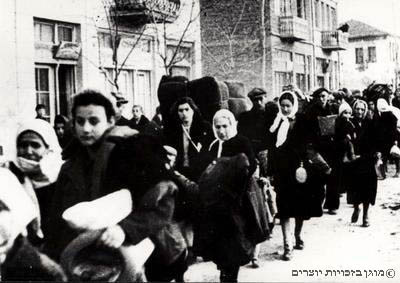
Three ghettos were established in Salonika: two open ghettos and a third closed ghetto that was actually a transit camp for deportation to the east. This section, the "Baron Hirsch" quarter, was located close to the railway tracks. The transfer to ghettos was difficult and rife with human tragedies. The Jewish police set up by the Germans oversaw the transfer to the ghetto. This police force had 250 members, most of whom had previously served as junior officers in the Greek army, plus refugees from Central Europe. The Jewish police were headed by Jack Albala, who spoke German and was close to the occupation authorities. The transfer to ghettos was completed on March 6, accompanied by a order forbidding Jews to leave them. Conditions in the ghettos were difficult. Each apartment had 3-6 families in it, with housing density sometimes reaching 30 people in a 16-square meter area. The severe crowding immediately gave rise to sanitation problems, and epidemics began to spread. Before the Jews were concentrated in ghettos, 2,500 people lived in the Baron Hirsch neighborhood, to whom 1,700 more Jews were added all at once. The entire neighborhood was surrounded by a wooden wall topped with barbed wire.
On March 10, the public learned that about 300 railway carriages had arrived at the Salonika railway station. Rabbi Koretz and the members of the committee working with him sent Max Merten, the adviser for civil matters in the German military government in Salonika, who was also responsible for dealing with the Jewish population, a document offering to waive half of the community's property, including land and buildings, if he called off the transports. 24 hours later, Merten notified them that he had received a negative answer to the proposal from Berlin. His claim was that various Greek organizations were demanding the expulsion of the Jews from Salonika. On March 13, 1943, Merten sent another decree to Rabbi Koretz ordering that the Jewish assets in the city be confiscated and handed over to the Germans. The assets involved included immovable assets, cash, and other valuables. The decree required the community to hand over its assets to the Germans by March 15. Dieter Wisliceny was put in charge of carrying out this order. On March 14, one day before the first transport left Salonika, Rabbi Koretz gave a speech to the Jews in the Baron Hirsch camp. He told them that the young people would continue working in camps in Greece, and that their parents would be allowed to continue living in Salonika. The first transport left for Auschwitz on the following day, and reached its destination on March 20. Transports from the Baron Hirsch neighborhood in Salonika to Auschwitz continued for five months: five transports in March, nine in April, two in May, one in June, and two in August. Jews who were citizens of the Axis powers and neutral countries, such as Turkey and Spain, were exempted from deportation. 850 such Jews lived in Salonika: 500 Jews with Spanish citizenship, 280 Italian citizens, and Jews with Turkish, Portuguese, Argentinian, Swiss, Egyptian, Hungarian, and Bulgarian citizenship. Whenever a transport left, the Baron Hirsch neighborhood in the ghetto was filled up again with Jews transferred there in preparation for the next transport. There were 1,000-4,500 Jews in each transport.
Jews from other communities in Thrace and Macedonia were added to the transports leaving Salonika. At the end of April, 316 Jews from Veria and 372 from Florina were sent from Salonika. 900 Jews from these cities and districts were also sent in May. According to the German records, 19 transports carried 48,533 Jews from Salonika to Auschwitz. At the same time, setting a definite total for the number of Jews deported is difficult, because it is known that one transport with 46 railway carriages and an unknown number of Jews went to the Treblinka death camp. One theory is that this transport left Salonika between March 23 and March 27, and may have contained Jews from Thrace and Macedonia. 11,147 young Jews (7,000 men and just over 4,000 women) were selected for camp labor from the transports from Salonika to Auschwitz. All the rest were sent to the gas chambers.
The special fate of the Salonika Jews at Auschwitz-Birkenau has been documented in both the testimony and memories of the survivors from Salonika and in the testimonies of Jewish prisoners from other European countries who were in contact with them. In contrast to the Jewish prisoners from Poland and Central Europe, Greek Jews arriving in Auschwitz were unused to the harsh Eastern European climate. The cold, exhausting work, difficult living conditions, and the crisis of losing their families in the gas chambers wreaked havoc on them. In the early months, they had severe communication difficulties, because they spoke neither German, Yiddish, nor Polish, which were the main spoken languages in the camp. Their stereotype, at least in the early months, was negative, and various derogatory names were attached to them. They even suffered blows and insults from other prisoners, because they did not understand what was said to them. The Salonika Jews were nevertheless considered a large and important labor force in the camp. They were renowned for their diligence and physical ability, and their special conditions made them a unified and cohesive group among the prisoners.
The young people who arrived in Auschwitz from Salonika in the spring and summer of 1943 were used mainly to build the sheds and crematoria in Birkenau and to work in the factory in Monowitz-Buna. Others were sent to labor companies working outside the main camp, and worked in mines or in various kinds of agricultural work. In the fall of 1943, several hundred prisoners were sent from Auschwitz to a labor camp built on the ruins of the Warsaw Ghetto. Their job was to clean the ghetto ruins. At least two groups of Jews were sent to the camp, which was built on Genesee Str., and most of them were Jews from Salonika. A first group of about 500 laborers arrived in Warsaw in August, and a second group arrived in October 1943, also numbering about 500 laborers. They were selected because they did not know Polish, and so were unable to communicate with the Polish population. In January 1944, there was an outbreak of typhus among the laborers in the Genshovka camp, with several dozen prisoners dying daily. Another group of prisoners, this time composed mainly of Hungarian Jews, arrived in May-June. With the evacuation of the camp, the Germans murdered about 300 sick people who could not be evacuated. Most of the Greek prisoners were removed from the camp in July 1944, before the outbreak of the Polish uprising in Warsaw.
In contrast with the fate that befell the Jews in Salonika and in the German occupation zone, the Jews in the Italian occupation zone in Greece had a much happier fate in the first two years of the war. 12,500 Jews lived in this area. During the war, refugees from other areas made their way to Athens, where about 3,000 Jews lived before the war, bringing the number of Jews in the city to 7,000-8,000.
From the beginning of the Italian occupation until September 8, 1043, when the Germans invaded the Italian zone, the Italian authorities protected the Jews. The Italians did not surrender to German pressure, refused to enforce anti-Jewish regulations, and even called on the Greek population to help and support the Jews. On September 20, however, after Italy surrendered to the Allies and the Germans entered the Italian occupation zone in Greece, measures began to implement the Final Solution in these areas as well. Wisliceny was sent to Athens, and was followed by General Jurgen Stroop, who had shortly before completed the destruction of the Warsaw Ghetto uprising and the deportation of the last Jews from Warsaw. Anton ("Toni") Burger replaced Dieter Wisliceny in January 1944.
In early October 1943, Stroop published street posters and a newspaper notice requiring Jews in Athens, including foreign citizens, to appear for registration at the synagogues in the city. The Germans ordered the Jews to appoint a "Council of Elders" to represent their affairs. The Germans nevertheless appointed a new community board headed by Moshe Sciaki and Isaac Kabili. After Sciaki's death in January 1944, Kabili was appointed to take his place.
The Jews in Athens did not hurry to register as the Germans had ordered. Jews with means quickly fled, and several hundred of them managed to reach the mountains and hide in remote villages. A total of about 3,000 Athenian Jews obtained forged papers and dispersed in Athens and the surrounding area. A group of young Greeks and other residents were of great assistance in hiding the Jews and finding escape routes and hiding places for them. After a month, the number of Jews registered fell to only 2,000, of whom 300 were Italian citizens and 200 Spanish, Portuguese, and Turkish citizens. Most of the Jews who registered were very poor and unable to find hiding places in exchange for property or the food coupons they had received. They received special identity cards from the Germans, and everyone aged 14 and up had to assemble daily for inspection. They were forbidden to circulate in public places between 5:00 PM and 7:00 AM.
In March 1944, the Gestapo spread rumors that the Jews would receive matza and sugar for the Passover festival at the synagogue on Melidoni Street in Athens. On March 23, Anton Burger, Eichmann's new representative in the city, went there and told the Jews assembled in the synagogue that they would be sent to labor camps in Germany until the end of the war. The doors of the synagogue were closed, trapping the Jews inside (one source says that there were 300 Jews there, while another source gives the figure of 700-1,000 Jews). The trapped Jews were led to the Haidari temporary transit camp, where the men were separated from the women and imprisoned in barracks. The imprisoned men were joined by their families the next day, bringing the number of Jews there to approximately 1,500. After a few days, more Jews who had been seized in the provinces were brought there, making a total of 3,000 Jews in the camp.
On April 2, 1944, 1,300 Jews were deported from Haidari to Auschwitz. Jews in the camp who were Swiss or Turkish subjects were released. Among the deportees were Jews with Italian citizenship, who were not awarded preferential treatment by the Germans after Italy surrendered to the Allies, and Jews with French, Bulgarian, Hungarian, or German citizenship. There were also Jews from other cities beside Athens. This transport reached Auschwitz on April 11.
There are several estimates for the number of Greek Jews murdered in the Holocaust. The difference between them stems largely from the fact that we have no accurate figures for the number of Greek Jews before WWII. According to figures from one source (historian Hagen Fleischer), there were 71,611 Jews in Greece before WWII, of whom 58,885 were murdered by the Nazis. According to figures from Michael Molcho and Yosef Nehama, 79,950 Jews, including the Jews of Rhodes, lived in Greece before the Holocaust, of whom 10,371 survived. According to a protocol of the board of Jewish communities in Greece that convened in January 1945, 67,203 Jews lived in Greece before WWII, and the number of Jews in January 1945 was 9,825.
After the Germans retreated, the remnants of Greek Jewry began to leave their hiding places and return to their homes. In October 1944, the Greek government rescinded the discriminatory laws decreed by the Germans and announced full equality for the Jews. The number of Jewish survivors in Greece after the was estimated at 10,000, of whom 1,500 were children in various hiding places, many of them orphans. 65% of the survivors were men, and only 35% women. Most of the survivors went to Athens, Salonika, and Larissa. In January 1945, there were 4,985 Jews in Athens and about 2,000 in Salonika.
The return home was not easy: the search for absent relatives; the struggle to regain family property, involving lengthy legal hearings; and the civil war that broke out in Greece – all of these were difficult for Jewish survivors who were trying to rebuild their lives. Like other communities of survivors in Europe, many of the survivors preferred to move on and find themselves a new land where they could begin new lives. The Land of Israel, and starting in 1948, the State of Israel, were the main immigration destination for Greek Jews until the mid-1950s. Other countries to which Greek Jews immigrated included the United States, Canada, Australia, and several Latin American countries. The immigration greatly diminished the number of Jews in Greece, which by 1951 totaled only some 6,000.
